



Introduction
Client
Motionhouse
Live at
motionhouse
Year
2026
Role
Product design and full-stack build
Duration
Ongoing
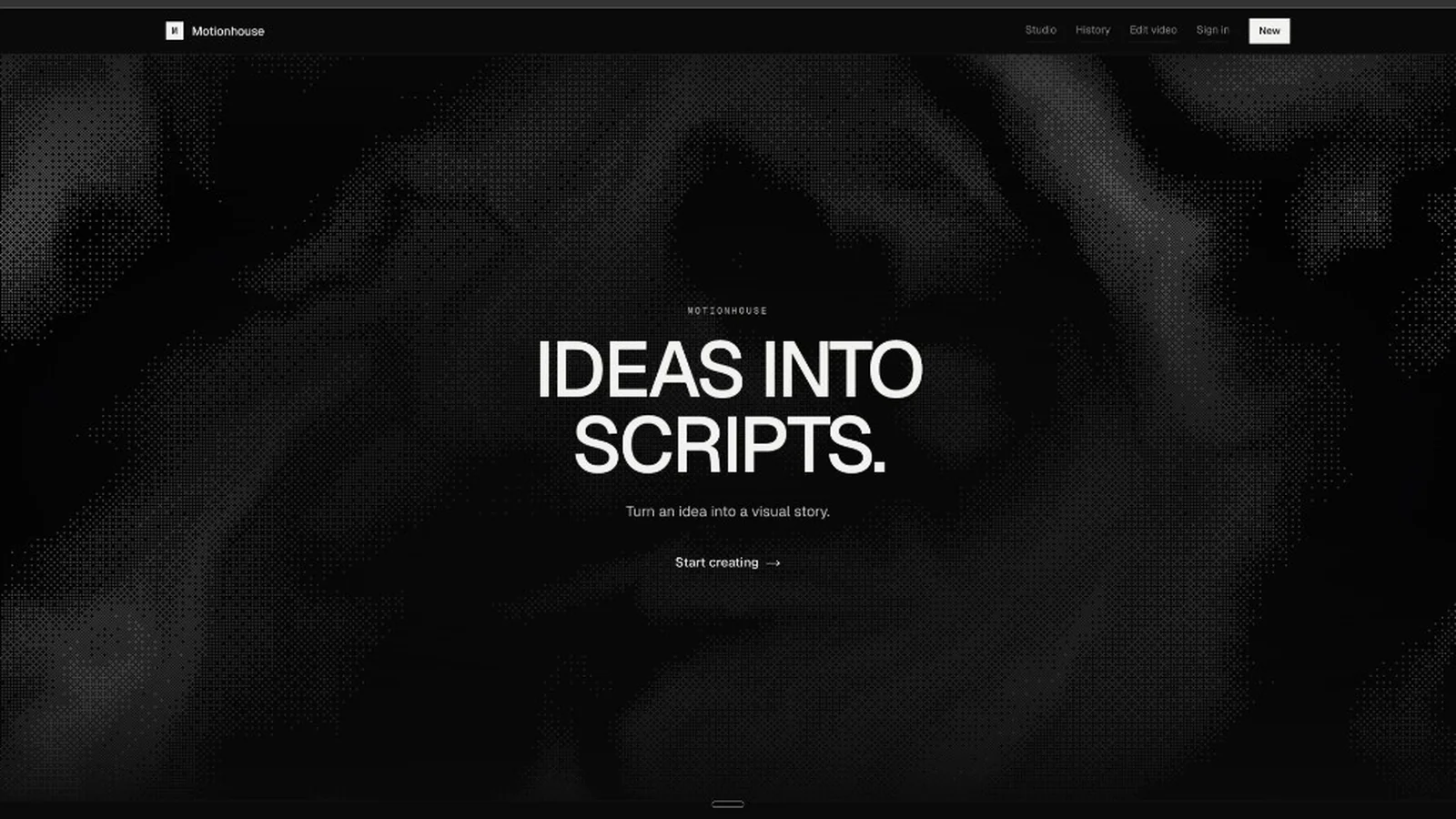
Motionhouse turns an idea into a finished video: script, storyboard, narration and animation, generated rather than assembled. Nothing comes from a stock library — every scene is rendered from scratch.
Challenge & Approach
Generated video usually falls apart at the seam between voice and motion. If the narration and the stroke are a beat out of sync, the whole thing reads as cheap, no matter how good the script is.
The other failure mode is a black box. Producers will not adopt a tool that hands back an MP4 with no way to change scene four.
- Word-level timing between narration and animation
- An editable plan, not an opaque render
- Two visual registers from one pipeline
- Export that is genuinely final, not a draft
The Solution
The system writes the script, builds the storyboard, generates the narration and animates the scenes — with per-word timing so marker strokes and kinetic type land on the syllable. Two engines share the pipeline: Drawn Whiteboard for explainers and teaching, Modern Frames for kinetic typography and stat cards. Between generation and export there is a real editor: direct the video in plain language, adjust individual scenes, read the per-word transcript, and keep the project data editable.
Key features
- Concept to script to storyboard to narration to animation, automatically
- Drawn Whiteboard and Modern Frames engines on one pipeline
- Natural-language direction plus per-scene manual control
- Per-word timing transcripts you can inspect and correct
- Upload existing footage for editing, or export MP4 and keep iterating
By the numbers
0
Stock clips used2
Render enginesPublished by Motionhouse on motionhouse.
Outcome
A production studio that behaves like an editor rather than a slot machine — which is what makes it usable for a second video, and a hundredth.
Services used
Next case studies